Friday, 20 April 2012

Evaluation/ Reflection

Positive:

Through the module I feel that my curation abilities have progressed, I am now confident about the processes involved in organizing an exhibition.

I have more confidence to trust my judgment and develop my ideas further.

I am pleased with the visual representation of my virtual exhibition, the drawings clearly show what I am describing and help to show the viewer what I want to achieve in the curation concept.
Using an underground, not widely visited space inside the gallery to show work that explores hidden areas of society- areas we would not usually be allowed inside revealing their secrets. (Beautiful, strange, intriguing secrets.)

Negative:

I am unsure whether the design for Stuart Whipps work inside the filing shelves and David Rowans on the pull out shelves is too much. I wanted the pieces to engage with the space, creating a psychological and physical link between the subject matter of the work and the archives they are shown within. However, I think my ideas may be too over the top forcing this relationship, feeling contrived.

I would like to experiment with the positioning of David Rowans work, where each of the 18 photographs are placed and how they interact with one another. Certain pieces may look more effective with others but, this is a finer detail to consider that would perhaps change with the actual hanging of the pieces.

On an end note I really enjoyed the challenge this module provided me with. Before this module I had no knowledge I how to curate an exhibition, I have gained valuable skills that will help with my professional practice and how to show my practical work in the future.

How the work is displayed is as important as the work itself.

Thursday, 19 April 2012

Press Release

NO ENTRY: New exhibition opens at New Art Gallery Walsall

23 April- 4 May 2012: ‘No Entry’, exploring the hidden secrets of spaces not usually inhabited through the work of David Rowan, Stuart Whipps and Janet and Louise Wilson.

The exhibition brings together the works of three artists who delve into locked areas of society. Located in the archives of the gallery ‘No Entry’ allows for an insightful investigation into hidden spaces and the events that happen behind closed doors.

 Jodie Wingham, curator of ‘No Entry’, said: “From the beginning of the curation process I knew I wanted to exhibit the works within a space that is not open to the general public. Therefore, it seemed a natural development to locate the works within the underground archives of the gallery. The physical act of entering the archive through the stainless steel lift provides an unnerving atmosphere. When the lift opens and you are faced with the Wilson sister’s film installation ‘Gamma’ encompassing the corridor you immediately feel trapped, unsure of your surroundings and unsure whether you should be in the space.  But ‘Gamma’ draws you into the corridor; the Wilsons’ camera evokes a sense of oppression, paranoia, and terror imparted by the prospect of War through the now deserted American military base in Berkshire, England.

It was important that the selected pieces engaged with the space. David Rowans photographs from his “Pacha Kuti X” are attached to the large movable walls used for storage, forcing the viewer to physically pull the images to view them. Stuart Whipps ‘487 Uncatalogued Boxes’ are shown on the shelves of the archive filing system with the slides projected around the room, maneuvering around the space and onto the different surfaces.

I want the exhibition to be an experience, resembling the subject matter of the pieces looking into No Entry areas devoid of human contact, abandoned and left to decay.”


END

NO ENTRY- My virtual exhibition


Corridor: After exiting lift
Janet and Louise Wilson, 'Gamma' (1999) Film installation.
There will be no lights, the film 'Gamma' by the Wilson sisters is projected onto the white walls  illuminating the space. This in turn shall reveal the underground nature of the archives and the ceiling (strangely beautiful with the pipes being visible)


Room : Stuart Whipps- '487 Uncatalogued boxes' (2011)- film installation
Located in filing room of archives.
Dim lights by shelves to illuminate the boxes but leaving the room dark enough for the projection slides to be seen.


Room: David Rowan '“Pacha Kuti X”. (2011-2012) Located in storage room with pull out wire walls. 18 c-type photographs three attached to each wall. Six walls in total


Wednesday, 18 April 2012

Reply - Cathy Wade

Dear Jodie.

I hope it has all gone well and seeing the spaces has resolved your queries. The amount of artists you use is up to you, it could be one or three hundred (basically whatever suits you and the space best). The choices you have so far sound great together, let me know how you are getting on, either space would suit both works so go with your own preference.

Best Cathy
On Mon, Apr 9, 2012 at 8:39 AM,
Hello Cathy,

It is jodie here, we discussed contacting Walsall Art gallery about using their archives for my virtual exhibition. I have a meeting with Cheryl on tuesday to discuss my plans and to take photographs.
However, I am still a little confused as to what is expected.
I have an idea to formulate a glass floor to my space where Christian Boltanski installation with tin boxes shall lye on the floor instead of vertically with little light to illuminate them. In the two corners of the room I would like to show the wilson sisters film statsi (the german police head quarters) However, this consists of two artists and two pieces of work- how many artists do we need to use or is it completely open?
My initial idea was to use a space not usually seen to show pieces of work about a buildings hidden secret or its past.
Any advice would be much appreciated , I have also contacted trove to visit the gallery as its appearance reminds me of a abandoned part of a building and with its history as part of the science museum it seems fitting with what I'm trying to achieve.

Thank you
Jodie

Tuesday, 17 April 2012

17th April- Meeting with Cheryl

Today Cheryl Jones agreed to take me around the archives at Walsall Art Gallery. My original idea was to use this space to hold my virtual exhibition or use it as inspiration for my own designed area.
The tour consisted of walking down a dark stair well that ended with a white door opening through to the large archive space.
I felt that I was entering a space not usually visited which fits perfectly with my concept.
The area consisted of one large room filled with the gallery's collection. Massive crates containing sculptures and a pull out grid wall system where paintings and drawings are hung upon for storage.

A small room containing a extensive filling system on pull out shelves.

A large room with high metal shelves for storage of tools and equipment.

A large corridor leading to the end of the archive space.
Opposite the corridor was a large metal stainless steel lift for transporting pieces of work to the exhibition space.

Monday, 16 April 2012

Reviewing past exhibitions.

48 sheet project- Birmingham (on till the 29th I can still make it yes!!!)

48Sheet is a project aiming at transforming the city of Birmingham into an urban gallery. From the 2 29 April 2012 up to 100 10ft x 20ft 48Sheet billboards are being used by artists for creative expression.

Artists across the world have created work to exhibit on a large scale across the city. Responding in different ways they have accepted the challenge of responding to traditional advertisement through their art.  By creating a network of unique and distinctive responses that will raise levels of consciousness and arouse cultural curiosity.
Image: MadeIn Company
48Sheet aims to create a large scale artistic intervention into the city of Birmingham for people to discover within their everyday journey’s across the city and region. Advertising free clusters of billboards have been created to transform the city of Birmingham into an urban gallery. Routes across the city have been mapped to encourage people to explore the 48Sheet public art trail”.
The name 48Sheet refers to the size of a traditional billboard. Billboards serve to expose brands and advertising messages across the world- bastions of a globalised consumer culture with their steel feet firmly planted in the midst of infinitely diverse and complex human life. 293 million people in 3,400 of the world’s largest cities see JCDecaux’s advertising structures every day. Such highly visible images are designed to evoke reaction- 48Sheet will redefine the reach of art by utlising such prominent public advertising platforms in this unique way”.
The above project pop up’ space has evolved into an organic gallery with numerous installations, paintings and will host a programme of events by 48Sheet featured artists from the 19th April”. 

Friday, 6 April 2012

Artists

 No.1 Janet and Louise Wilson
Much of Janet and Louise Wilsons work focuses on abandoned interiors. Within these spaces the artists draw attention to the presence of those who once occupied them or the acts that were carried out inside. The results are eerie films, almost haunted, that entrap the viewer within the experience.

Stasi City (1997) (running time 5:40) consists of a 4 projection installation (positioned in opposite corners of the gallery)exploring the controversial history of the former quarters of the East German secret police. The film depicts corridors, interrogation rooms, opened and closed doors exploring the psychology of the space that sought to control and survey the population during the Cold War. Entrapping the viewer within the film and the space they take on the role as the all-seeing eyes similar to the Stasi police themselves.
Crawl Space, (1995) (running time, 9:00) conveys a suspense/horror motif. Projected on a single surface, it disjointedly follows the sisters through an abandoned house, replete with slamming doors, hints of telekinesis, and amorphous shapes writhing beneath the wallpaper.

Gamma was filmed at Greenham Common, an American military base in Berkshire, England, that housed cruise missiles during the Cold War. Decommissioned in 1992, the base now lies deserted, its history captured by the Wilsons in disturbing images that seem both documentary and surreal. Moving through area after area of the site, the Wilsons’ camera evokes a sense of oppression, paranoia, and terror imparted by the everyday materials of military reality and the prospect of nuclear war. A film consisting of a combined styles ranging from Hollywood to TV melodrama create an intense film that absorbs the viewer.

No. 2 David Rowan
 
Name of Piece: Pacha Kuti X”. (2011/2012)
The unseen underground
18 C-Type Photographic Prints 1016mm x 762mm

Information about the piece: (http://www.davidrowan.org/work/pachakutiten/)

An exploration of 17th-20th century dystopias, myths and concepts of the apocalypse. Pacha Kuti is underground landscape photography depicting hidden, sometimes unknown or forgotten subterranean environments. An investigation of the lesser-known and below ground environment of the Birmingham and Black Country region of England.
The name Pacha Kuti or pachacuti refers to an Inca apocalypse legend, a time of duality and change and roughly translates as the time when the world will turn upside down’.
Pachakuti number 10 is the 10th End of The Known Universe according to the Inca legend which states there have been many pacha kuti over many generations.
According to Inca Predictions the 10th Pacha Kuti began in the year MCMLXXXVII (1987)


criollo V
C Type Photographic Print 1016mm x 762mm


No. 3 Stuart Whipps
 
Name of Piece: 487 Uncatalogued Boxes”. (2011)
Rotational Slide Projectors. Slides. Custom Brackets
487 cardboard boxes.

Information about the piece: (Sourced: http://www.stuartwhipps.com/exhibitions/ikongallery/)


Trove may be viewed as off the beaten track. Surrounded by industrial buildings it could very well blend into the industrial qualities of the area- appearing as an abandoned building. I want the spectator to feel as if they are entering a place that they are not supposed to be in. This may make them feel as if they are intruding in the space- like a person feels when they are entering an abandoned house or factory. Inspired by Jane and Louise Wilson works such as Gamma, Crawl Space, Statsi City and what did the building see? I want to exhibit pieces that contain themes or techniques that the spectator would not usually encounter in everyday life. This may include an insight into another world, another culture, a personal story, a personal act, a historical place, a abandoned home etc- something that makes the viewer feel as if they are a voyeur. (Allowed to be in this space, view these pieces only for the purpose of this exhibition)

Trove- Birmingham

My curation concept:

To use a space that is not inhabited. I am focusing on two spaces:
 1. The possible archives/ basement areas of Walsall Art gallery
 2. Trove gallery space in Birmingham
I am meeting with Cheryl at Walsall on Tuesday the 16th April- leaving me little time to plan the placement of work, this is problematic.
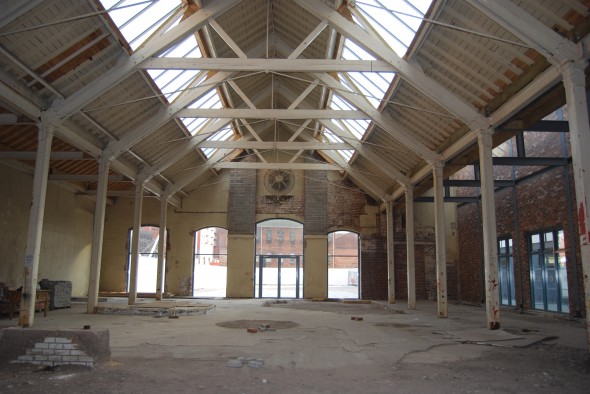
However, Trove may be suitable to stage my virtual exhibition. Trove appears as an abandoned room located in Birmingham’s jewelry quarter. It is based in the Engine Room of Birmingham’s old Science and Industry Museum. Prior to the Museum the site was home to Elkington Silver Factory, the first silver-plating factory in the world. The historical narrative behind the space provides an excellent place to exhibit works from Louise and Jane Wilson whose films are staged within the confounds of disused buildings and factories.
TROVE

Thursday, 5 April 2012

A quick visit to Ikon gallery- Birmingham

With time to spare I decided to embark on a visit to Ikon gallery, snowing heavily it provided a shelter from the elements.
There were three exhibits, Sarah Browne 'How to use fool's gold', Hamish Fulton 'Walking in relation to everything' and postcards from Japan- a message from Tohoku Artists.

Sarah Browne- an eclectic mix of pieces ranging from installations, sculpture, film and projection. Browne produces a poetic attempt to create something out of nothing, the title of the exhibit focuses on the making of fool's gold an attempt to make something of worth out of nothing = impossible. I have to admit I found certain elements of the exhibit confusing which did nothing for my enjoyment of the work (but who says that an exhibit should be enjoying!). However, within the second room there was an inspiring usage of film, slides and object usage that combined together to tell a story. This is my own interpretation, the black and white film portrays a woman making a rug. In the centre of the room hanging from the ceiling is a rug, projected onto a wall near the rug are slides of people wearing woollen jumpers. Moving from the film we see the usage such a skill produces appreciating the beauty and craftsmanship of ordinary objects- jumpers and rugs which we take for granted within our everyday lives. I found the development of a theme through the positioning of pieces of work inspiring. Other aspects of the exhibit that I thought different were the hand typed literature accompanying the works simply suck to the wall.

Hamish Fulton describes himself as a ‘walking artist’, with his work joining the two separate disciplines of walking and art. It is from 1973, having walked over 1000 miles in 47 days from Duncansby Head to Land’s End, Fulton decided to ‘only make art resulting from the experience of  individual walks.’

Hamish Fulton
Consisting of wall pieces, each piece is large in size painted directly onto the white walls of the Ikon gallery. Walking has remained central to his work calling for political justice, for indigenous cultures such as the Australian Aborigines and Tibetan Independence. By painting directly onto the wall the pieces become part of the space, they also become temporary. At the end of the exhibit they will be painted over and no longer exist,  thus becoming the past. What does this suggest?


Evaluation:


Things to consider when curating
1.  White walls, this provides a plain background for paintings to be hung, films to be projected onto ect. Allowing the pieces to stand out focusing the spectator’s attention. However, the space can feel clinical. This effect can alienate the audience as it can be seen as an unnatural setting- possibly causing the spectator to feel uncomfortable as if they are intruding. With such spaces there are pros and cons that have to be considered.
2.  Floor? Wooden, carpeted or tiled. Do you want the footsteps of the audience to be heard?
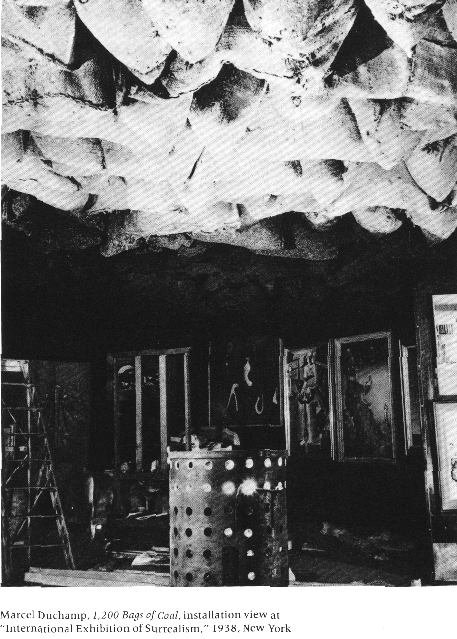
3.  Do you want to allow easy viewing for the spectator or make them work? Marcel Duchamp’s 1,200 Bags of coal (1938) uses the ceiling of the space, the ceiling becomes the floor. He designed revolving doors to the gallery space leading in and out trapping the audience as they entered and exited adding to the confusion of the exhibition. (O’Doherty 1967:69) Similarly, his Mile of String’ (1942) creates a trap for the audience. Clear viewing of the works was impossible causing frustration.
4. Title?
5. Theme?
6. Selection of works, juxapositioning of aesthetic appearance. Isolation of works? Why choose these works?

Wednesday, 4 April 2012

Inside the White Cube - Brian O'Doherty

An investigation into the modern gallery space "constructed along laws as rigorous as those for building a medieval church". The art gallery becomes similar to a church a sanctified space devoted to the appreciation of art. According to ODoherty the outside world is cut off from the gallery space, the walls are usually white and the ceiling acts as the light source. He paints a picture of the white cube gallery space that we have all become conditioned towards when viewing modern art, the Ikon gallery in Birmingham could be viewed as such a space for example.
I cannot help but agree with ODoherty when he states, We have now reached a point where we see not the art but the space first”, (ODoherty 1976:14) when I visit a gallery the first thing I notice is the space in which the art is seen. The space becomes intrinsically linked to the work, having the ability to dramatically change the effect the work can have upon the viewer whilst in that area. Although I have not read the text in depth through my initial reading it is clear that the gallery space is not passive. Unconsciously or consciously (in some exhibitions) the space effects how we view a piece of work, therefore it can be viewed with the same level of importance as the work itself!

Contacting Walsall New Art Gallery:

By emailing the gallery I have been able to arrange a meeting with Cheryl Jones, Library and Collections Curator. Having thought my proposal interesting she is willing to show me around the gallery and further discuss my idea which is great.
This provides me with the opportunity of a personnel tour of the gallery archives, I can take pictures of the space or drawings that can be used to visually document the exhibition.
(Having an actucal place, within close proximity,to base my exhibition provides a solid base for the virtual exhibition to take place.)  

Tutorial- Cathy Wade

Friday 29th March

My idea: to show works such as Jane and Louise Wilson films, Tacita Dead chalk paintings and others yet to be selected- final selection needs more thought.

I want to exhibit these pieces within a space that is not usually seen by the public. This could include disused factories, areas within buildings that are not usually seen or not open to the public. Having previously discussed using areas of a gallery not within the public gaze Cathy gave me an excellent idea to curate my exhibition within the basement or archives of Walsall New Art Gallery. This allows me to visit the space (with permission) and gain an exact idea of the space and how I can exhibit works within the area.

My curational concept: To use an area of the art gallery not open to the public.

In the beginning......... (Research)

Forming a link with my own practice and the virtual exhibition:
My work focuses on documenting past memories of places no longer inhabited and facing inevitable destruction. With continuing research and development I have gathered together artists who have used a similar subject matter within their own practice. These artists have influenced my work and it would be interesting to gather them together within a space to exhibit.

Tutorial:

Discussing my practical work ideas have emerged that can be incorporated into the virtual exhibition. Janet and Louise Wilson

Creating a fantasy exhibition

Virtual Exhibition includes:
 
A visual presentation of an imaginatively curated show. This can take the form of either architectural plans including the positioning of the work, digital presentation with photoshopped images, a maquette or an on-line visual presentation
Images with titles of work, including artist/s name/s
Title of Show
Press release about the curatorial concept
Print out of your individual Blog site and /or a Reflective journal - which includes your contextual research/ critical reflection throughout the module.
All work to be submitted to Staff Office Corridor S.02 Top Floor
Monday 23rd April-the first day of back of the summer term
Please make sure put your name on your submission.